Tanzania Cardamom: Origins, Production & Sourcing Guide
Overview
Cardamom is not a crop most buyers associate with Tanzania, and that instinct is largely correct: the country is a minor origin by global standards. But it is a real, historically significant one. Commercial cultivation dates to the early twentieth century in the East Usambara Mountains, and by the mid-1970s Tanzania was, by some accounts, the world’s third-largest cardamom producer, contributing roughly a fifth of global output — a position since lost decisively to Guatemala and India, which together dominate world supply today. Recent trade-intelligence estimates put Tanzania’s current production under half a percent of global volume.
Production & Growing Regions
The best-documented cardamom belt is the East Usambara Mountains in Tanga Region, specifically Muheza and Korogwe Districts, centered on the area around the historic Amani Botanical Garden, with Lushoto District also part of the wider spice-growing range. Cultivation traces to a small planting at Amani in the early 1900s; commercial spread to smallholder farms accelerated after 1954, when the garden distributed seedlings more widely. A second, independently documented area is the Uluguru Mountains in Morogoro Region — a 2024 household survey covering 542 spice-farming families confirmed cardamom as an active cash crop in both landscapes. Tanzania’s spice-sector strategy has also referenced Mbeya Region in connection with cardamom, though this is more thinly documented. Cardamom in the Usambaras is grown almost entirely as an understory shade crop beneath forest canopy.
Harvesting & Drying
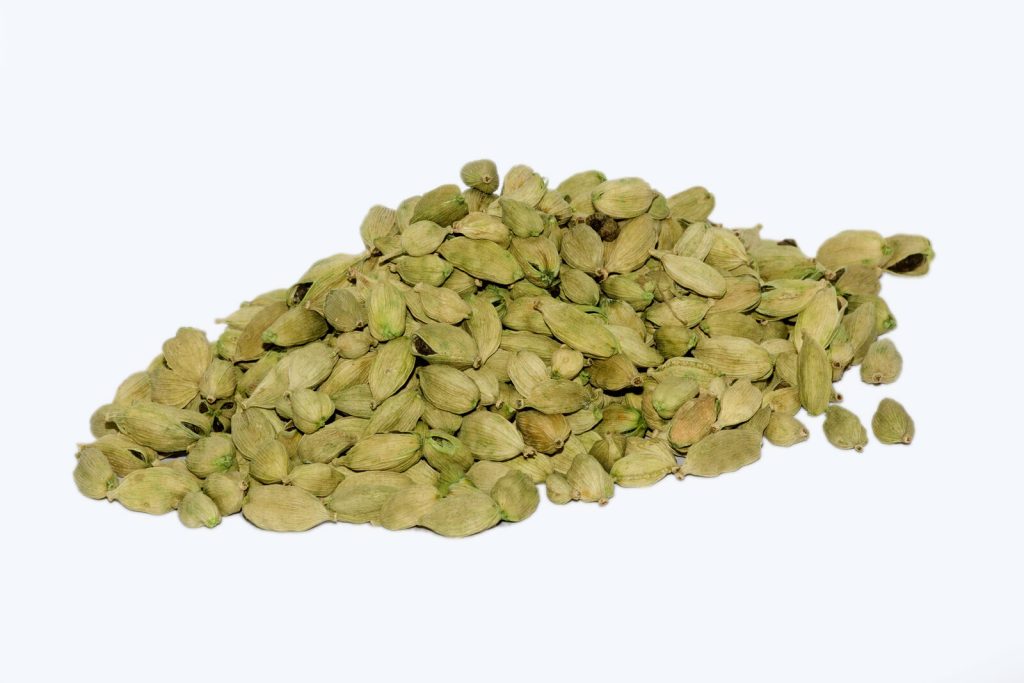
Harvest runs over an extended season, with mature capsules picked by hand individually roughly every three weeks as they ripen. Historically, higher-grade green cardamom was produced by fire-curing over wood-fired driers, as still used in India and Guatemala. In the Usambaras this has largely given way to sun-drying, producing a creamy-white rather than green capsule — a shift researchers attribute to firewood scarcity as forest cover has declined. Sun-drying on open roadside mats also carries a documented contamination risk. More recent reporting describes Muheza farmers being encouraged toward organic practices and improved processing.
Quality & Grading
International cardamom grading is based primarily on capsule size and color, with plump, vividly green pods commanding premium prices and yellow, brown or bleached capsules marked down. Tanzania’s historic shift toward sun-dried, white-toned capsules puts most output outside the premium green-grade segment that dominates specialty and Gulf/Middle East markets — a structural disadvantage relative to Guatemala’s fire-cured green cardamom. No published Tanzania-specific official grading standard could be verified; the government-linked Tanzania Spices Label references purity, freshness and quality testing generally, but a cardamom-specific technical standard within it could not be confirmed.
Market Context & Trade
Globally, Guatemala and India account for the large majority of production, with Guatemala alone supplying more than half of world exports; the Middle East and North Africa absorb most world demand. Germany sourced about 4.1% of its cardamom imports from Tanzania in 2023. Trade-intelligence estimates put Tanzanian cardamom production at roughly 800–820 metric tons annually in recent years, ranking around eighth globally by volume — these figures come from a commercial trade-data platform rather than an official government or FAO series and should be read as industry estimates. The Tanzania Spices Association lists organic, highland-grown cardamom among member-produced spices, reflecting continued smallholder and cooperative activity, though it does not publish production or export figures.
Current Market
No verified current market observation is available for this commodity yet.
Suppliers
- Bioone / Mountain Research and Development — Small Cardamom—Precious for People, Harmful for Mountain Forests — https://bioone.org/journals/mountain-research-and-development/volume-26/issue-2/0276-4741_2006_26_131_SCFPHF_2.0.CO_2/ — 2026-09-24
- International Society for Horticultural Science — Cardamom in Tanzania — https://ishs.org/ishs-article/21_24/ — 2026-09-24
- Sokoine University of Agriculture — Livelihood strategy choices among spice farmers in the Eastern Arc Mountains of Tanzania — https://www.cfwt.sua.ac.tz/foresteconomics/livelihood-strategy-choices-among-spice-farmers-in-the-eastern-arc-mountains-of-tanzania/ — 2026-09-24
- The Guardian (Tanzania) / IPPMedia — Climate change threatens cardamom farming in Muheza — https://www.ippmedia.com/the-guardian/features/read/climate-change-threatens-cardamom-farming-in-muheza-as-farmers-adopt-organic-practices-2024-10-14-180204 — 2026-09-24
- CBI (Netherlands Enterprise Agency) — The European market potential for cardamom — https://www.cbi.eu/market-information/spices-herbs/cardamom-0/market-potential — 2026-09-24
- Tridge — Tanzania Whole Cardamom market overview — https://www.tridge.com/intelligences/cardamom/TZ — 2026-09-24
- Tanzania Spices Association — Official website — https://www.taspa.or.tz/ — 2026-09-24